
Moose facts
Moose & people
People have long been fascinated by the moose – probably for as long as we have lived side by side. Above all, the moose has been an important game animal, and still is, though not in quite the same way. Moose migrated up into Sweden and Scandinavia after the last ice sheet retreated.
Sweden’s forests are home to plenty of moose: the Swedish population is estimated at between 300,000 and 400,000 animals, and across its entire range there are thought to be as many as 1.5 million. On the international Red List, which records the status of the world’s animals, our moose is listed in the lowest category of concern – in other words, moose are plentiful across their current range. But it hasn’t always been that way. In the early 19th century the Swedish moose population hit record lows, with only a few small, isolated populations remaining in central Sweden. However, after hunting strategies changed and the number of predators fell, the population began to recover. Today around 100,000 moose are shot during the annual moose hunt.
Yet even though Sweden has plenty of moose, they are still quite hard to spot in the wild. That’s probably because they are rather shy – they are, after all, prey animals. Moose are also active at times when we aren’t out in the forest. The main reason we keep moose here at Wrågården is to give everyone an easier way to see the Swedish moose – and, all right, also because Henrik (the owner) thinks it’s fun.
What is a moose?
The moose is the largest species in the deer family, known in Latin as Cervidae, which also includes roe deer and reindeer. A moose can reach a shoulder height of up to 235 cm and weigh up to 550 kg. The female is called a cow, and before she has had her first calves she is called a heifer, while the male is called a bull. The cow is smaller than the bull: in autumn, females typically weigh between 270 and 360 kg and males between 380 and 540 kg. The males also have a thicker neck and throat and more of a beard.
The moose is an even-toed ungulate, which means it has an even number of toes – unlike, for example, the horse, which has an odd number, namely one. The moose has four toes: two of equal size, called hooves, and two slightly smaller ones, called dewclaws, which sit behind the others. The hooves are covered in horny tissue that makes them hard-wearing. A moose’s hooves grow constantly and need to be worn down so they don’t get too long. They are larger than those of other deer, such as roe deer, and a moose track measures 12–16 cm in length.
Our moose are well adapted to life in a cold climate, with a large body volume, a dense coat and long legs. Their bulk and coat help them keep warm, and their long legs let them move more easily through deep snow. The coat is thicker in winter and the hairs are hollow, which adds to its insulating effect.
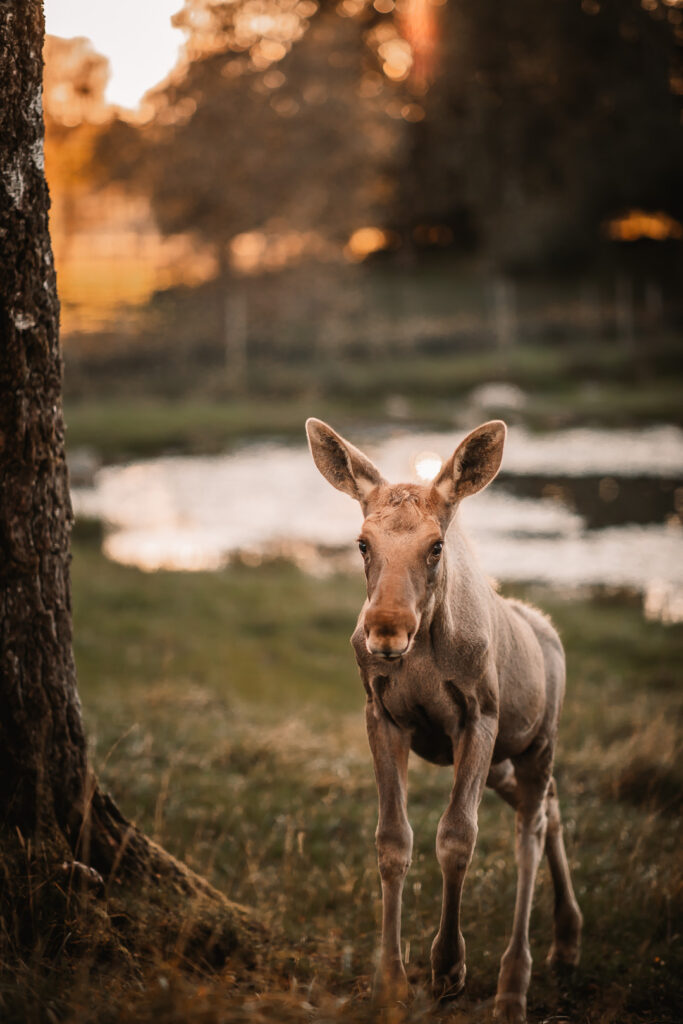
The coat colour can vary from dark brown to black, but also from light brown to grey. The legs are almost always a pale greyish white, and in females this pale colour extends up towards the base of the tail. A newborn calf has a completely different coat colour from its parents – reddish brown – and keeps it throughout its first summer.
The moose also has long ears that it can turn in different directions, picking up sounds from several directions at once. Its eyes protrude slightly, and because they sit on the sides of its head, the moose can see behind itself without turning its head. The moose also has a beard under its chin, which is a little longer in males than in females. Its muzzle is long and slightly drooping, and its mouth is large. The moose has 6 incisors in its lower jaw, plus 2 canines and 12 molars, whereas it has “only” 12 molars in its upper jaw. Instead of incisors and canines, it has a “pad” in the upper jaw.
Studies have shown that moose living in areas with harsh snow conditions had larger hooves and longer legs relative to their size than moose living further south. The large hooves, which also splay more as the animal walks, stop the moose from sinking deep into the snow. Another sign that the moose is adapted to life in snowy regions is that it can lift its hind legs higher and use a special gait when the snow is deep. Moose living where there is a lot of deep snow have also been seen walking in each other’s tracks. This is thought to be because it saves energy, as trudging through snow is extremely tiring.
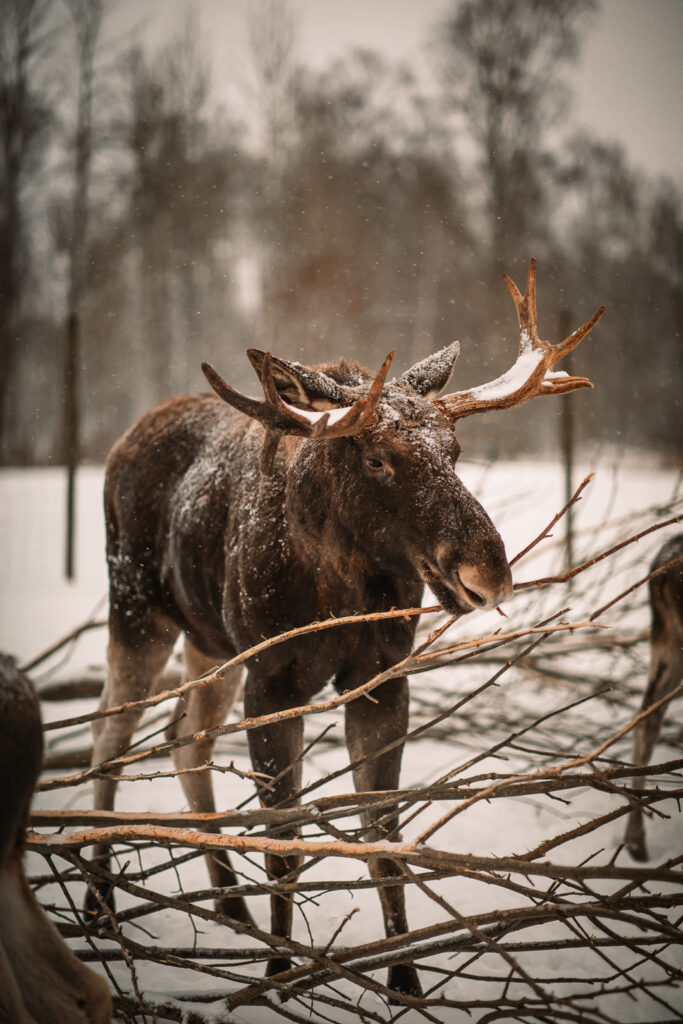
The easiest way to tell males from females is that the males carry antlers for part of the year. Moose antlers are made entirely of bone and come in two different types: spike-type (cervicorn) antlers or palmate antlers. Cervicorn antlers are rounded, slender and branched, while palmate antlers are flat and shaped like a shovel. Bulls shed their antlers every year after the mating season, and new ones start growing again fairly soon after. In late winter you can see the new antlers taking shape. While they grow, the antlers are covered in a special skin called velvet. Beneath the velvet, nerves and blood vessels branch out to nourish the antlers as they grow. Just in time for the next mating season, the blood supply withdraws and the velvet dries out. The bull then rubs or scrapes the velvet off. Growing new antlers every year takes a lot of energy, and a bull’s antlers are at their largest when he is between 5 and 12 years old. As the bull gets older, the number of points on his antlers decreases and they become smaller – the antlers are then said to be going back. The main purpose of the antlers is to signal the bull’s condition and status, both to the cows and to rival bulls. They can also be used as weapons in a duel with another bull.
Distribution and habitat
In Eurasia the moose has a wide geographical range, stretching from Scandinavia in the north southwards through Poland, northern Ukraine and northern China, and eastwards all the way to the Yenisei River in Siberia and parts of Mongolia. Because the moose is so well adapted to a cold climate, it is prone to heatstroke – which is probably also why it hasn’t spread further south in Europe.
The largest populations are found in Sweden, Norway, Finland, Russia, the Baltic states, Belarus and Ukraine. There used to be a moose population in Austria, but it has since died out. The Swedish moose population is estimated at between 300,000 and 400,000 animals before the hunting season.
The moose prefers damp ground or land bordering water. But it is also found in farmland, open lowland landscapes and mountain regions, as long as there is forest nearby. In summer, moose seem to prefer young woodland habitats near damp ground and arable land, while in winter they choose pine heaths, willow thickets and other young woodland.
Moose don’t have a territory that they defend against others; instead they have home ranges. A home range is an area an animal stays in for a certain period, such as a summer or a winter. These home ranges vary in size depending on the moose’s sex and where in Sweden it lives. Studies of moose in northern Sweden have shown that they migrate between summer and winter ranges. The moose populations that changed home range in winter moved to areas with less cultivated land, and the moose were also seen to prefer forests with more pine and spruce. Home ranges in northern Sweden were also generally larger, possibly because there is less food available there – the moose has to cover a larger area to get the same amount of forage. Studies have also shown that outdoor recreation and hunting make moose move around more and change home range more often.
Diet
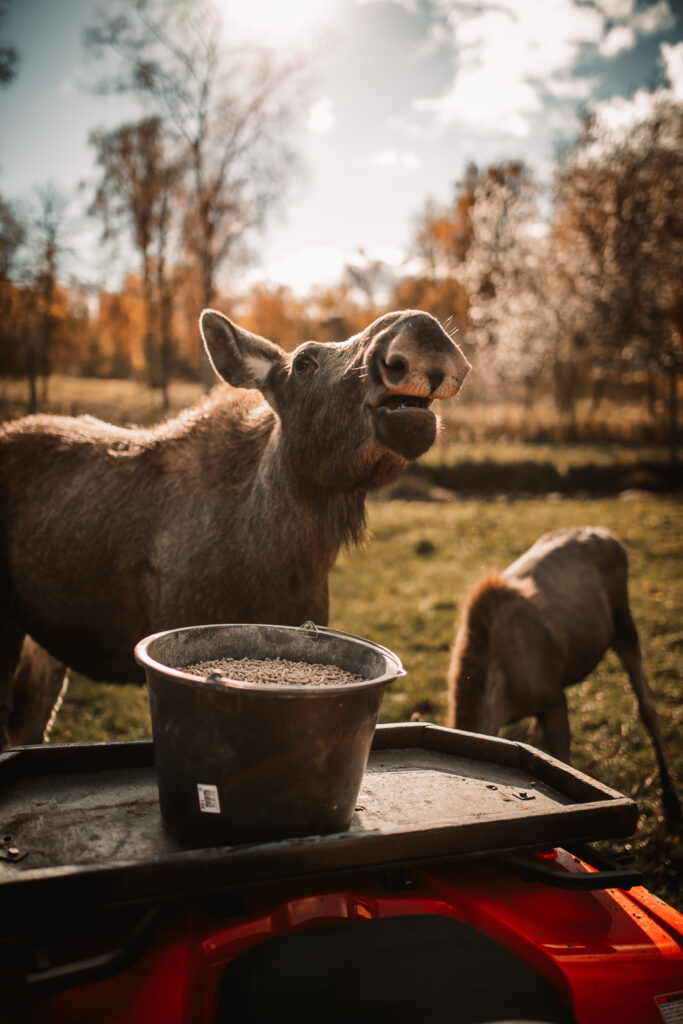
The moose is a browser and belongs to the group of herbivores known as selective feeders and ruminants. Being a selective feeder means the moose carefully chooses what to eat – not just which plants, but also in which area and which part of the plant is best. Research has shown that moose are good at judging the quality of forage and adapt the way they graze and search for food accordingly.
Moose mostly eat leaves, shoots, twigs, the tops of young trees, as well as dwarf shrubs and various herbs. They eat a wide range of plant species; some favourites are birch, goat willow, pine, spruce, rowan, oak, aspen, bilberry, rosebay willowherb, heather and certain grasses and aquatic plants. Which plant is eaten most also depends on the time of year, and differences in diet have been observed between summer and winter. In one study of Swedish moose, the winter diet consisted mainly of birch and goat willow, followed by pine and juniper. Pine usually dominates the winter diet, as young pines tend to be plentiful. In summer, the moose mostly browsed deciduous trees of various kinds, above all birch. Summer is also when moose eat herbs and aquatic plants. In the transition from winter to spring, and in late autumn before winter, moose eat a lot of berry shrubs and heather. In spring, moose can also be seen stripping bark from conifers. An adult moose needs to eat 3–6 kg (dry weight) of shoots and plant parts a day to meet its nutritional needs. Moose eat more in summer than in winter, and in winter they live largely off the reserves they built up over the summer. Losing weight over the winter is nothing dangerous – the moose is well adapted to it.
The moose is also a ruminant, which means it regurgitates its food and chews it a second time. Like a dairy cow, the moose has four stomachs, or stomach compartments: the rumen, the reticulum, the omasum and the abomasum. When the moose has grazed and chewed for the first time, the food ends up in the rumen. The rumen is the largest of the stomachs, and it is here that the chewed food lands first. In the rumen, microorganisms start breaking down the food. The rumen then passes the half-digested food on to the next stomach, the reticulum. Digestion continues in the reticulum before the food is brought back up to the moose’s mouth to be chewed again – this re-chewing is called ruminating, or chewing the cud. Once the moose has chewed the food for a while and mixed it with more saliva, it swallows it again, but this time it goes not to the rumen but to the omasum. In the omasum, excess water is absorbed from the food. The food then moves on to the final stomach, the abomasum. This stomach is most like our own and contains substances that break the food down into nutrients small enough to be absorbed by the moose’s intestine. In this way the moose can make use of even hard-to-digest food, such as woody parts of trees. Whatever the intestine can’t absorb comes out as droppings.
Reproduction and mother–calf behaviour
The moose rut takes place in September–October. The bull starts the mating season by rubbing the velvet off his antlers. But before moose can mate, they have to find each other, since they don’t live together all year round and mostly live alone. Animals that spend most of their lives on their own are described as solitary.
Bulls have various ways of signalling to the cows (and to rival bulls) in their home range what a fine bull they are. One is scent-marking in the forest, by stripping the bark off certain trees a little way above the ground and then rubbing against the bare patch. It is thought that the scent of the freshly stripped tree helps spread the moose’s own scent. Another way of signalling is for the bull to dig what are called rutting pits. The bull digs a pit with his front legs and urinates in it. He then tramples the pit, splashing the mixture of urine and mud over himself, or wallows in it. Cows have also been seen doing the same in these rutting pits. The urine contains scent compounds that reveal the condition of the bull that dug the pit.
The cow is only receptive to becoming pregnant for a single day. If she hasn’t met a bull by then, it takes another 3 weeks before she can conceive again. Like the bull, the cow reaches sexual maturity at 2 years of age. So a cow can give birth to her first calves in her third year, but it is more common for the first calves to arrive when she is 4. Bulls, on the other hand, usually have to wait a few more years before getting the chance to mate for the first time. The cow is pregnant for 8 months and usually gives birth in May. Twins are common, but this depends on the cow’s age, her size and what the weather was like the previous summer. It has been shown that a wet, cold early summer followed by a dry, warm high summer puts the cow in good condition for the rut, which increases the likelihood of twin calves the following year.
To show how the behaviour of calf and cow changes during the calf’s first year, the year can be divided into 5 different periods. In the first few days after birth, the calves are very inactive, move poorly and stay in close contact with the cow. The cow and calves now establish a suckling routine, and it is the calf that calls for attention when it wants to feed. Cows have been observed lying down more during these first days so that the calf can reach the udder.
Over the next 20 days the calf begins to imprint on its surroundings. Its ability to move improves day by day. It stays very close to the cow and now develops a following behaviour, following its mother wherever she goes. The cow grazes within a limited area and avoids straying too far. If she needs to move further away, she hides the calf in a carefully chosen spot.
The third period falls between 20 and 90 days of age. The calf now starts exploring its surroundings a little more on its own – you could call it practice at being alone. It also takes more of an interest in solid food, tasting branches and herbs. The cow still shields her calf from social contact with other moose, and also protects it from other intruders, such as people or horses that come too close. At 3–4 months of age, the calf is allowed to meet other moose, especially bulls. It is around this time that the cow comes into season and is courted by the bulls in the area. The calf is now eating more solid food and stops suckling altogether at 4–5 months of age. It will stay close to the cow until she gives birth to new calves in May, when the now year-old calf is driven away. After that, the young moose stays in the area around its mother.