
Bison facts
Before the arrival of Europeans, it is estimated that there were up to 60 million free-roaming bison on the continent. At that time, the bison’s range stretched from northern Mexico to Alaska. Plains bison were found mainly on the fertile plains from northern Mexico all the way up to central Alberta. From central Alberta to Alaska, wood bison were the main type.
Today there are around 500,000 bison in North America. About 97% of them are kept for commercial purposes, such as meat, hide and fur production. The remaining 3% or so are kept for conservation in wild or semi-wild conditions, for example in larger protected national parks and reserves. The herds kept in these protected areas are often small. According to the International Union for Conservation of Nature (IUCN.org), there are only 5 herds of plains bison and just 3 herds of wood bison with more than 1,000 individuals. Small, isolated herds pose a threat to the species, as they can lead to inbreeding if there are too few individuals or if no animals are exchanged between herds. The bison kept to preserve them for future generations occupy less than 1% of their original range.
Bison and humans
Today bison are classed as Near Threatened (NT) on the international Red List of the world’s threatened species – the third-lowest category. But the small populations of plains and wood bison that are not kept for commercial purposes are in need of conservation measures by humans.
What brought the world’s bison population to the brink of extinction was excessive hunting by European settlers during the 19th century. Bison had certainly been hunted before the Europeans arrived, but only on a small scale, since the Indigenous peoples originally had neither horses nor modern hunting weapons. The Indigenous peoples also depended on bison for food and clothing, and took only what they needed. Reducing bison numbers through excessive hunting became an effective way for the settlers to control the Indigenous population: it reduced their independence and made them dependent on government support instead, which the settlers could control.
Today the greatest threat to both plains and wood bison is that they live in small, isolated herds. Herds with few individuals can lead to inbreeding, which in future may make the population less resistant to, for example, disease and less able to adapt to things like environmental change. Another threat is the mixing in of genes from domestic cattle. In the early 20th century, when only about 20 bison remained in some places, cattle breeds were crossed in to “save” the species. There are populations with no trace of these genes, but since they roam close to bison herds kept for commercial purposes, there are fears they will interbreed. Other threats today include human expansion into their home range, cattle ranching and too little land being set aside for reserves.
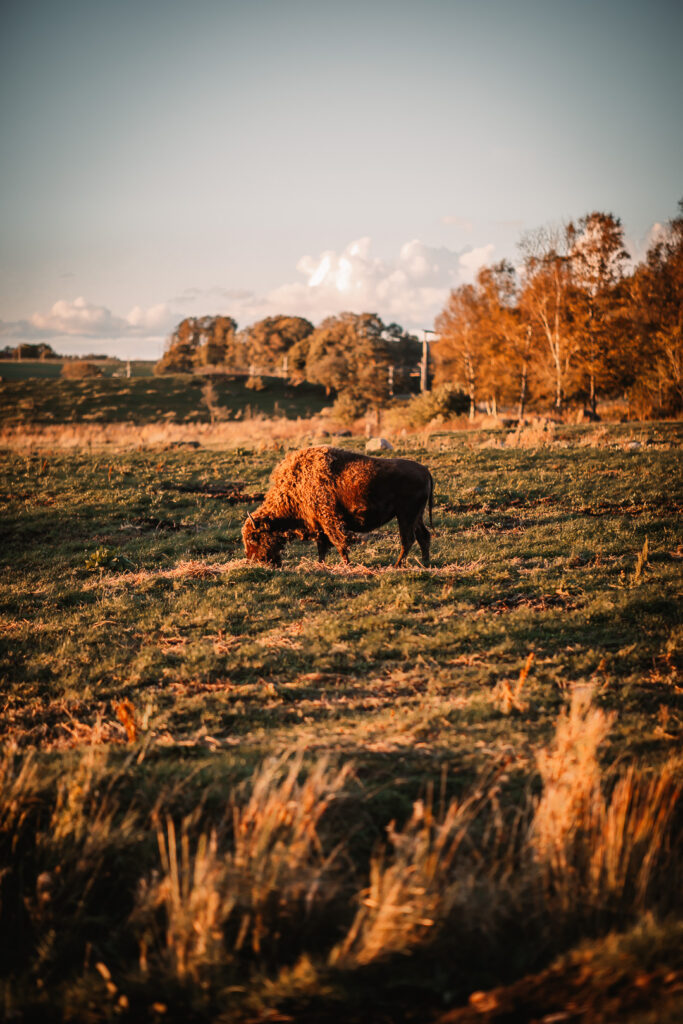
Why conserve bison?
When bison disappeared from the American plains, it wasn’t just an iconic symbol of the West that vanished – the entire ecological balance of the area changed too. As bison are grazing animals, their grazing affects the presence of many different plant species, which in turn affects insects, other grazers and small animals. Culturally, bison played a central role in the culture and spirituality of the Indigenous peoples. They did hunt bison, but they depended on them and therefore also protected them. The ecosystem bison live in also provides us humans with various services, known as ecosystem services. It is our duty to preserve that balance, not only for ourselves but for everything that lives there. We do each other a favour by helping the bison return to the plains.
Ecology and habitat
Bison are grazers. They graze mainly on grasslands and in wetland areas. The Great Plains have large seasonal variations, with a short period of grass growth in spring, followed by slower growth during summer and autumn and no growth at all in winter. Bison have the largest range of any grazer in North America – from the desert-like grasslands of northern Mexico, via the fertile grassland of “the Great Plains”, to the innermost wetlands of Alaska. Bison eat mainly grasses and sedges but have a more varied diet in summer and autumn, when they may also eat flowers, leaves and shrubs. Which plants they choose depends on where they live, and there is great variation. In other words, bison are highly adaptable. Winters in some parts of their current range, such as Yellowstone, can be very harsh. Bison use their heads to sweep away snow to reach edible plants underneath. Plains bison are known to have migrated between summer and winter pastures before the settlers came. In the small populations that exist today, these migrations are not possible – settlements and reserve fences stand in the way.
Appearance
Bison have a distinctive appearance. They are impressively large, weighing an estimated 400–1000 kg. Bulls are heavier than cows, and both cows and bulls have horns. They belong to the taxonomic family Bovidae, which means their horns consist of a bony core covered in a horn substance similar to our nails. So unlike moose, for example, they don’t shed their horns – the horns keep growing throughout their lives. Other animals in the same family include our cows, goats and sheep. Just like these species, bison have hooves.
Bison also have a hump at the withers. This hump is formed by long bony projections from the spine, to which large muscles are attached that help hold up the heavy head. So there is no fat in the hump.
Adult bison are dark brown and have longer hair on the front of the body than on the rear. The hair on the head is short and curly. During the winter months they grow a very thick winter coat, which they shed in spring. To get rid of the winter coat, you can see them rubbing against trees and rocks. When calves are born they are reddish brown, very different from their mother. This helps them blend in with the dry summer grass when they are left alone. Calves take on the same colour as their mother at around 6 months.
Behaviour
Bison live in smaller family groups made up of cows and their offspring. This social system is known as a matriarchy – Swedish wild boar live in a similar way. Bulls up to 3 years old usually stay in these groups before leaving the herd and forming their own small groups of young bulls. Adult bulls live either alone, also known as solitary, or in small groups with other bulls outside the mating season. During the mating season, many family groups may come together in one large herd, which the bulls then seek out. The mating season falls in the summer months of July–September. The bulls then court one or more cows until they are ready to mate. They keep other bulls from coming close and block the cow’s view so that she can’t see other bulls. It is during this time that you can see rivalry between bulls. Usually it is just threat displays such as snorting and pawing the ground, but head-to-head butting can occur if the bulls are evenly matched. The winner goes on to court his cow. The most dominant bulls mate during the first 2–3 weeks of the mating season. Lower-ranking bulls get to mate with the remaining cows that come into heat late. It has been shown that bulls born early in spring usually rank higher than those born late in the year. They are generally larger and mate most often, so their offspring are born early in spring and are more likely to end up highest in rank. You could say that the calf inherits the conditions for achieving high rank.
The cow is pregnant for about 9 months and usually gives birth to a single calf towards early spring, when grazing is at its best. Studies of wild bison have shown that 80% of calves were born within a three-week period. If the cows live in an open habitat with no shelter from trees, a cow will usually choose to calve within the protection of the herd. But if there are trees or bushes in the area, she will slip away and calve apart from the herd, just as our domestic cows would in the wild. The bull plays no part in caring for or raising the calf – the cow does this on her own. The calf is fully weaned at around 5–6 months of age. Sexual maturity is reached between 2 and 3 years of age. In the wild, young bulls rarely get the chance to mate before the age of 6.
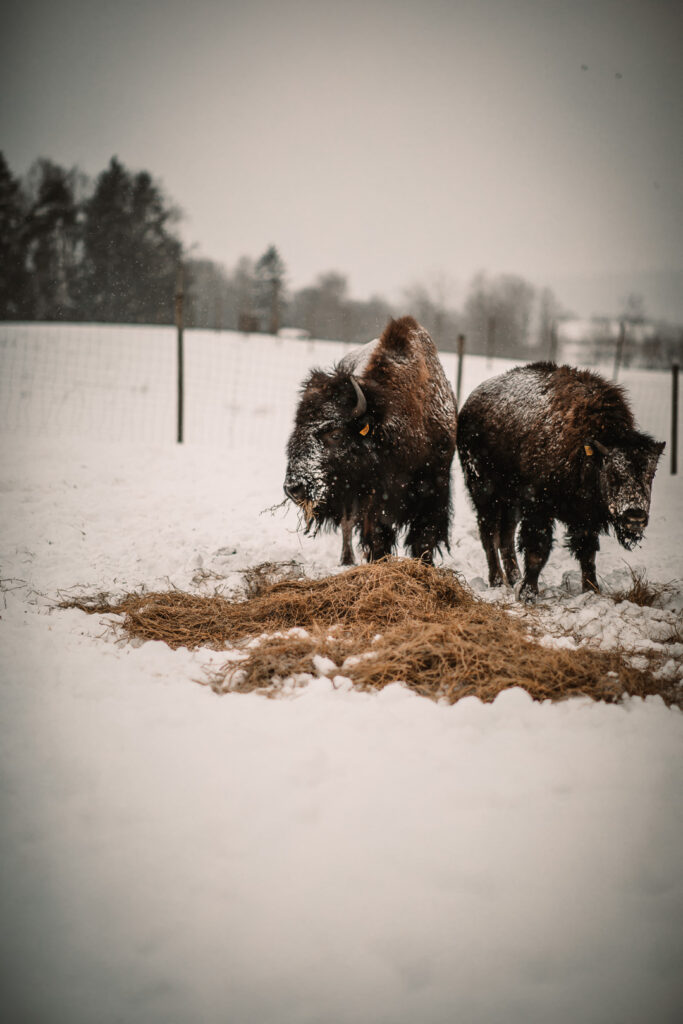
Did you know…?
- One fun behaviour bison show is that they love rolling around in shallow hollows in the ground. Sand is a bonus, and wet or dry hardly matters. There are various theories as to why they do it: to get rid of grease and dirt in their coat, to get rid of parasites (ticks), as play, or as a display during the mating season. Because of the hump on their shoulders they can’t roll right over, so they roll one side at a time. If you’re lucky, you might see our bison having a roll!
- That bison are closely related to our cows? They belong to the same taxonomic family, “Bovidae”. What similarities can you spot?
- In a few places in Europe there is a counterpart to the American bison. It is called the wisent, or European bison. It is critically threatened owing to heavy hunting pressure. It can be found in various nature reserves and zoos. In Sweden you can see it in a few zoos, including Borås Zoo.
- In the USA and Canada, a 300,000-hectare reserve is being created under the name “American Prairie Reserve”. It will become the largest reserve for a range of species, including the American bison.
- That bison have no front teeth in their upper jaw? Instead they have a hardened pad which, together with the tongue and muzzle, helps them graze. The bison wraps its tongue around the grass and uses the teeth in its lower jaw to cut it off. The first time it swallows the grass, it does so without chewing. Just like our cows, bison are ruminants and have four different “compartments” in their stomach: the rumen, the reticulum, the omasum and the abomasum. Being a ruminant means the bison chews parts of its food several times. Grass and woody plants such as brushwood are very hard to break down. Chewing the food several times makes the pieces of grass so small that the microorganisms in the rumen (the largest compartment of the stomach) can more easily help break it down. Being a ruminant has its advantages, as it makes it easier to digest different types of food – useful in winter, when forage can be scarce.
- In the wild, bison bulls lose up to 10% of their body weight during the mating season. Why is that? Well, the bulls graze very little during this time, and courting the cows while keeping other bulls away takes a great deal of energy. Outside the mating season, the bulls graze heaps and build up a thick layer of fat ready for the next rut.
- The bison’s thick winter coat is so well insulated that in winter you can see snow lying on their backs without melting!
Book a bison safari with us
We take bookings May–Sep.